UK Home Office Draws Extensively on 6Rang Research in Guidance on LGBT+ Asylum Claims from Iran
Research by 6Rang (Iranian LGBT+ Network) features prominently in UK government guidance assessing the risks of persecution faced by LGBT+ people in Iran.
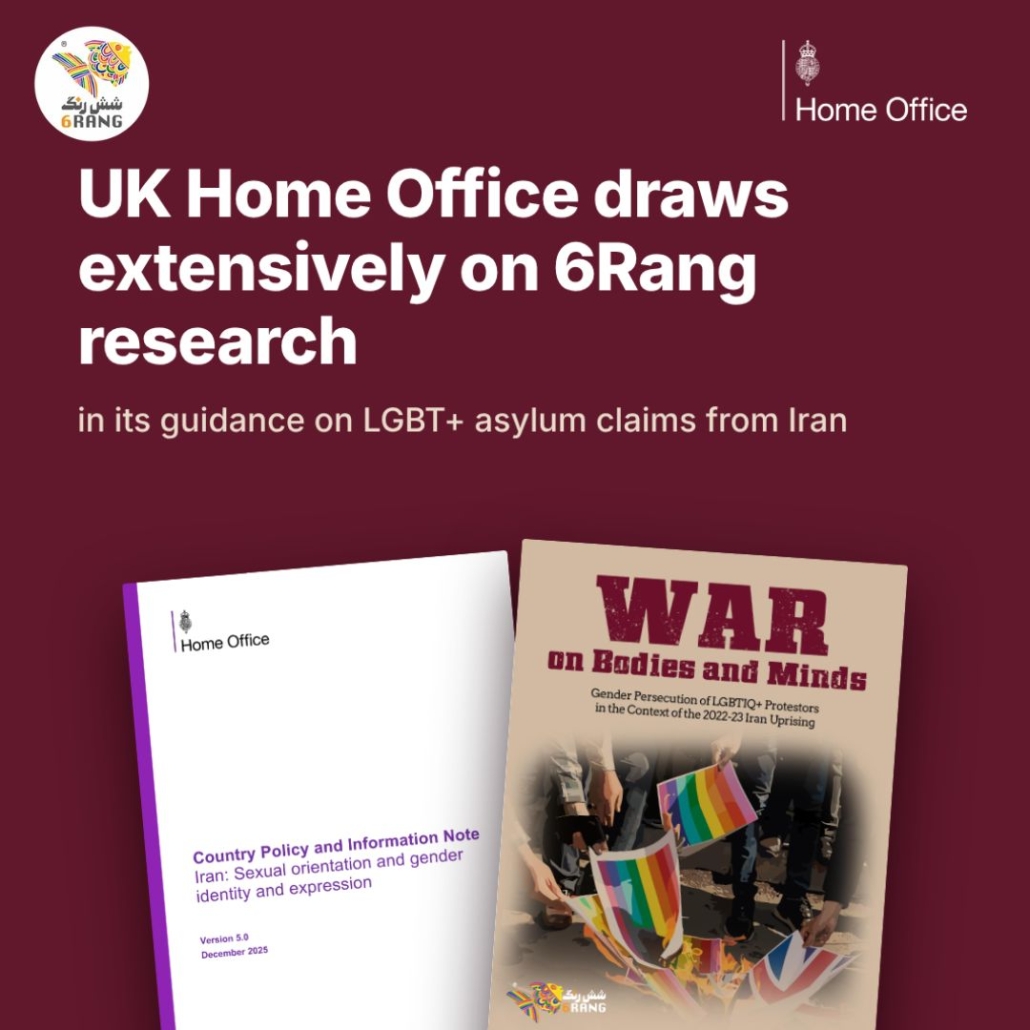
The UK Home Office’s Country Policy and Information Note on Sexual Orientation and Gender Identity or Expression in Iran, Version 5.0, dated December 2025 and published on the UK government website in January 2026, draws repeatedly on research and documentation produced by 6Rang to examine the legal, political and social conditions facing LGBT+ Iranians.
With approximately 80 mentions of 6Rang across the main text and footnotes, the guidance makes extensive use of the organisation’s investigations into criminalisation, coercive medical practices, official hate speech, violence and discrimination against LGBT+ people in Iran.
The guidance is intended to inform decisions on asylum and human rights claims in the UK. It concludes that LGBT+ people living openly in Iran who have not undergone legally recognised gender reassignment surgery are generally likely to face persecution or serious harm from state and non-state actors. It also finds that those with a well-founded fear of persecution are unlikely to obtain effective state protection or find safety by relocating elsewhere within Iran.
The Home Office recognises LGBT+ people in Iran as a particular social group under the Refugee Convention, while emphasising that each asylum claim must be assessed individually.
How 6Rang’s evidence informs the assessment
The document references 6Rang’s investigations across multiple areas, including criminalisation, coercive medical practices, official hate speech and the treatment of LGBT+ people during protests.
Conversion practices: The Home Office cites 6Rang’s research involving 210 respondents, of whom 105 (50%) reported having been offered or pressured to undergo so-called corrective or conversion therapy. Of these 105 respondents, 41 (39%) were under 18 when they encountered such practices.
Of the 105 respondents, 45 (43%) accepted or were compelled to accept these practices, including 15 who were under 18, while 60 were able to refuse them. According to 6Rang’s report, 61% of those who underwent the practices said they had no choice.
Criminalisation: The guidance cites 6Rang’s March 2023 report, Silencing Protests: Official Hate Speech Against LGBT People as a Tool of Suppression, in examining how Iran’s Islamic Penal Code criminalises consensual same-sex sexual acts, with punishments ranging from flogging to the death penalty. These provisions can also apply to children who have reached the age of criminal responsibility under Iranian law.
Source: Silencing Protests: Official Hate Speech Against LGBT People as a Tool of Suppression (March 2023)
Official hate speech and repression: The Home Office also draws on 6Rang’s documentation of official hate speech and violence against LGBT+ protesters during the Woman, Life, Freedom uprising.
In War on Bodies and Minds, based on testimonies from 70 LGBT+ protesters, 6Rang documented how individuals’ actual or perceived sexual orientation, gender identity or expression contributed to heightened violence and repression during protests and detention. The report records physical and verbal abuse, threats of outing, sexual assault and rape by security personnel and interrogators.
Sources: Silencing Protests: Official Hate Speech Against LGBT People as a Tool of Suppression (March 2023) and War on Bodies and Minds: Gender Persecution of LGBTIQ+ Protestors in the Context of the 2022–2023 Iran Uprising (September 2023)
Why this matters
Country-of-origin information plays an important role in assessing asylum claims. For people fleeing persecution, credible, independently documented evidence can help decision-makers understand risks that may be difficult for individuals to prove, particularly where reporting abuses to the authorities could expose victims to further harm.
The extensive use of 6Rang’s research in the Home Office guidance demonstrates the value of sustained documentation, survivor testimony and legal analysis in making the experiences of LGBT+ Iranians visible to international institutions.
For 6Rang, whose work combines human rights documentation, advocacy and support for LGBT+ Iranians, these references demonstrate how evidence gathered from affected communities can inform decisions about international protection and potentially influence government policies towards the Islamic Republic’s human rights violations against LGBT+ people.
Leave a Reply
Want to join the discussion?Feel free to contribute!